See it change colour
£7.5
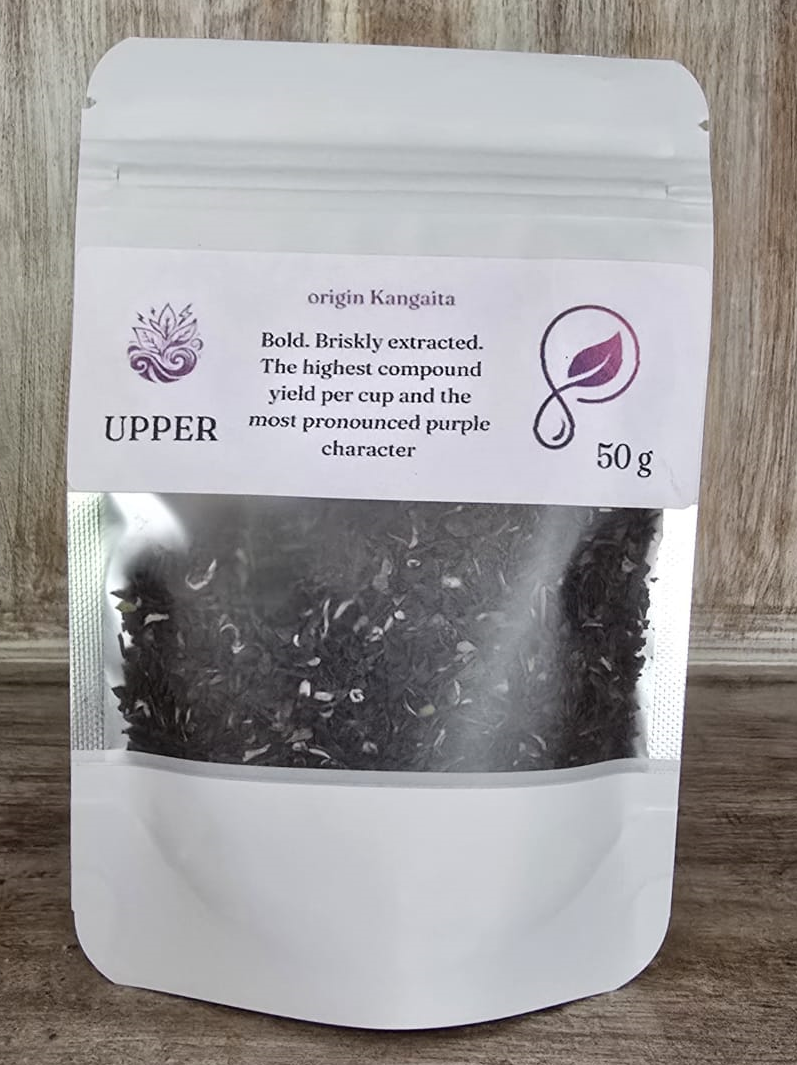
The Upper carries the most pronounced purple character — the anthocyanin colour-shift you can watch in the cup.
Most teas are about catechins. Purple T contains them — and a compound profile no other tea carries. The whole proposition is in that sentence. Everything else is the explanation.
Anthocyanins are the family of compounds that give blueberries, blackcurrants, red cabbage and aubergines their colour. They are present in the leaf of TRFK 306/1 at concentrations that produce a visible purple tint and, once brewed, a pale liquor that turns rose with the addition of citrus.
The colour change is a chemistry trick — anthocyanins are pH-sensitive, and a squeeze of lemon shifts them from blue-leaning purple to red-leaning rose. It is also, incidentally, the most photogenic moment in tea.
The published literature on anthocyanins, considered in food more broadly, addresses vascular function, lipid profile, and post-prandial glucose response. We are not, in Step 1, making any of those claims for Purple T specifically. The point in this section is compositional: the anthocyanin family is present in the cup, at levels not found in any other commercial tea.
Purple T's signature compound has an inelegant name and an elegant function.
1,2-di-O-galloyl-4,6-O-(S)-hexahydroxydiphenoyl-β-D-glucose.
It is shortened to GHG, and it is the most distinctive thing about the cultivar. It does not appear in green, white, oolong or black tea in any meaningful concentration. It is one of the things the Tea Research Institute of Kenya's selection programme produced over decades of patient cultivar work.
A 2014 human study by Shimoda et al. found that GHG-standardised purple tea extract was associated with measurable changes in body composition over twelve weeks of supplementation. We reference that study here for compositional context, not as a claim about Purple T as a beverage. The leap from extract to brewed tea, and from a single trial to clinical-grade evidence, is the bridge our own evidence programme is being built to cross. We will not cross it ahead of the data.
EGCG, EGC, EC, ECG. The catechin family is the polyphenol portfolio green tea is famous for, and Purple T contains the full spectrum. Not instead of the anthocyanins and GHG, but in addition to them.
This matters because the catechins are the part of the tea polyphenol story that is best understood. The scientific record is deepest there. By carrying catechins at green-tea-comparable levels and adding the anthocyanins and GHG, Purple T offers a wider compositional fingerprint than either green tea or matcha.
Caffeine, by contrast, is lower in Purple T than in matcha and comparable to or slightly below green tea. The full extraction of polyphenol content does not require the caffeine spike that ceremonial matcha delivers.
A great deal of polyphenol research, including for compounds present in Purple T, points in directions we find encouraging — metabolic markers, cognitive-wellbeing indicators, vascular signals. The honest position, as a tea brand at Step 1, is that the body of evidence on Purple T as a beverage, with the brewing parameters and dosage we serve it at, is in its earliest stages. The Shimoda extract study is one piece. A great deal more is required before we say more.
That is why this brand has three steps. The Tea — what is in the cup, today, is what this page is about. The Programme and the Proof are the chapters where the evidence is patiently built. We will not get ahead of the data.
The Upper carries the most pronounced purple character — the anthocyanin colour-shift you can watch in the cup.